Online Pokies Strategy Guide
Open a pokie info screen and it hurls a wall of numbers at you: RTP, volatility, max win, hit frequency. Rarely does it bother to explain what a single one of them actually means. Closing that gap is the whole job of this page, and it closes it with slots pulled straight from the catalogue instead of the tidy invented examples that only ever behave. Click any title and you watch the mechanic run on real reels.
Latest slots winning strategies







By feature
How Online Pokies Work
Strip a pokie back to its frame and the same few layers are there every time. The grid is the outermost one; inside it the reels and the rows you actually watch do the moving; and the pay rules bolt on over the top, either fixed paylines or ways, set by the build. Under all of it, largely unnoticed, sits the RNG. Take Big Bass Bonanza, about as clean a worked example as you will find: a 5×3 grid, 10 fixed lines, scatter-triggered free spins, and an RNG that decides every spin on its own. That is the whole skeleton.
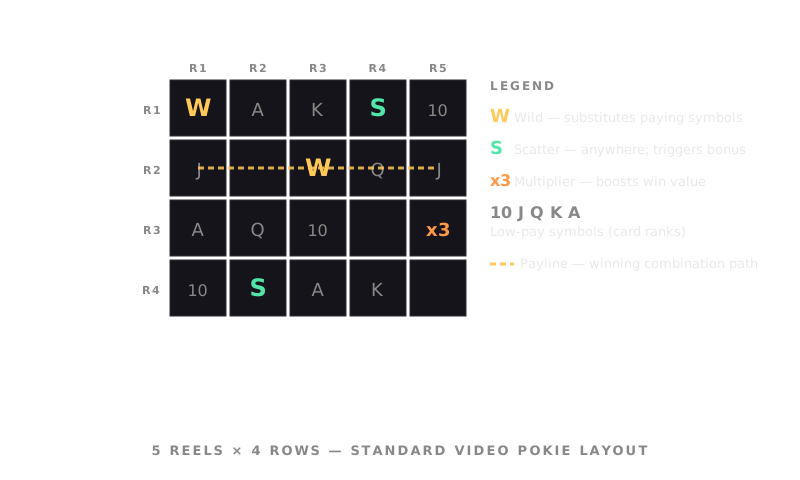
First of all, hold one picture in your head: Book of Dead. Five reels across, three rows down, ten fixed paylines, a 5,000x cap on the bonus round: that layout is the one to lock in. Once it is fixed, the ways-pays builds, Megaways, cluster grids shed the look of separate puzzles: they read instead as departures from the same baseline you are already carrying around.
Reels are the vertical columns you watch spin; rows are the horizontal slots they land into. Most 5-reel video releases sit on a 5×3 frame; cluster-pays formats push it out to 6×5 or 7×7; and a thinner slice of 3-reel classics still runs at the older end of the catalogue. Few of those classics survive, but the ones that do tend to hang onto a loyal audience.
The departures that actually matter are in the pay rules. On a fixed-payline build like Book of Dead, row position is everything: a winning combination has to land along one of the published patterns read left to right, and a symbol one row out of place simply misses. An “all ways” build throws the patterns away. Matching symbols on adjacent reels pay, and the build does not care which row any of them is sitting in. Megaways then takes that any-row idea and stacks variable reel heights on top, which is why the ways-count keeps sliding between 324 and 117,649 from one spin to the next.
Symbols are the next layer. For the working example, load up Gates of Olympus: a scatter-driven bonus trigger, plus floating multipliers that only count once they attach to a paid tumble. One 6×5 grid is doing two completely different symbol jobs at once.
Generalise from that and the symbol set on almost any pokie collapses into two paying tiers and three kinds of modifier. The low-pay tier is the filler: card ranks (10, J, Q, K, A) and fruit icons that round out the small base-game hits, nothing more. Up top are the themed symbols: gods, fish, characters, animals. Those are the ones carrying the bigger line payouts.
Modifiers are a different animal again. A wild stands in for any regular paying symbol on a line. A scatter ignores lines altogether, pays from anywhere on the grid and fires the bonus once enough of them land in a single spin. Multipliers, on their own, pay nothing at all; they merely amplify a win they already belong to. Common values are 2x and 3x, with 5x less common and the odd bonus round climbing higher still. That top end is rarer than the marketing lets on, mind you. A handful of titles carry a persistent multiplier too, one that climbs across consecutive free spins instead of resetting at the top of each. The persistent kind stays rare.
That leaves the RNG, and with it the whole question of fairness. Nowhere is RNG independence plainer than on Aviator, where every round either climbs or crashes with no memory whatsoever of the round before it. A long run of early crashes does not quietly load the next one toward a late finish. Each round starts fresh. That, in one sentence, is the whole idea. Honestly, this is the point players get wrong more often than any other, so it repays a second look.
Each spin outcome comes from a certified random number generator that runs independent of the last, so previous spins never feed into the next one. Does a cold streak earn a payout? It does not, however owed it feels. The three names you spot on certification footers are eCOGRA, GLI (Gaming Laboratories International) and iTech Labs, and they audit the pokies sold to AU-licensed operators. Their brief is narrow: test the RNG output, confirm the published RTP matches what the game returns.
Key Pokies Terms Explained
Nearly everything on the info panel is doing one of four jobs. One number is the return, and that one is RTP. Another describes the shape of the distribution, which we call volatility, with hit frequency riding alongside as a sibling signal. A third sets the ceiling, the max win cap. The last covers the grid rules, paylines or ways. Every modern title carries all four in some form; only the labels and the running order shuffle from provider to provider, and shuffle they always do, mind you.
RTP (Return to Player)
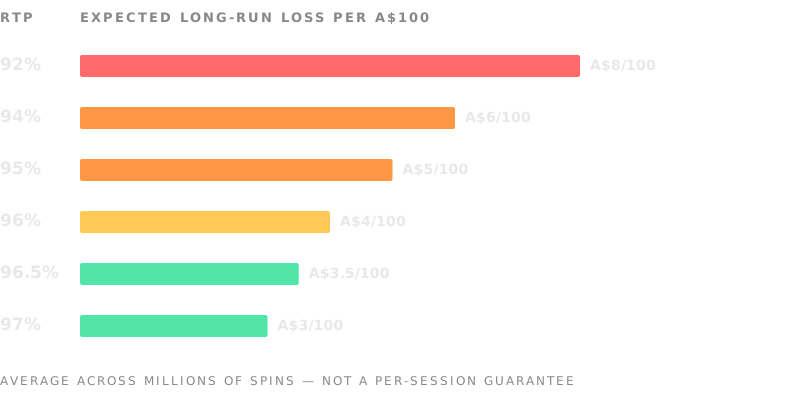
Take RTP, the return-to-player figure, first. Three quick reference points are enough to set the band. Big Bass Bonanza reads 96.71% on its current build. Money Train 3 ships at 96.10% base, then climbs to 96.50% with the Buy Feature live. Aviator reaches as high as 97%. In every case the percentage is pointing at one thing: the theoretical long-run payback per A$100 wagered, measured across millions of simulated spins in the lab. The decimals look fussy. Yet over a long enough session they run the whole game.
Across the wider industry the range you meet is 92% to 97%. A narrow spread? Hardly: over a long enough session those few points separate a bankroll that bleeds slowly from one that drains before your rhythm even settles. Modern 5-reel video releases mostly land between 95% and 96.5%, and anything under 95% is worth eyeballing twice before you hand it a whole session.
Then comes the catch that bends the metric out of shape, and it is a real one. Providers ship the same title in multiple RTP builds, 96.5%, 94% and 92% being the usual tiers, and the casino on the other end, not you, is the one that picks which build goes live (a detail the marketing tends not to volunteer). So, of course, the same game can run at different RTPs across different operators. So which build did you actually load? Only one place nails the deployed build down, and that is the in-game info panel: check it before the first spin, because nowhere else records the truth.
Volatility (Variance)
Volatility and hit frequency come next, and they read best as a pair. Two pokies can both show 96% RTP on the panel and still drop you in completely different rooms once the reels move. Razor Shark, rated high, stacks up long dry stretches between hits, then unloads the bonus with a 50,000x ceiling at the top. Sun of Egypt 3 also carries a high rating, yet it routes the return through a Hold and Win round into coin-symbol prizes capped at 10,000x instead. It is the same RTP shelf, and yet nothing about the session rhythm is the same.
Volatility, sometimes written as variance, is what drives that gap. To be fair, it ranks as the single metric that most changes how a session feels. Keep the two apart. Its scale runs low, medium, high, very-high. Here is the part that trips people: it sits entirely independent of RTP. Lean on a low-volatility build and you get frequent base-game hits and short dry spells. A high-volatility build flips that: rare hits, heavier when they finally land, with most of the return tucked away inside the bonus round itself, while medium volatility lives between the two and, by title count, covers a fair chunk of the catalogue.
In practice this is a bankroll instruction as much as a description. A very-high-band title such as Money Train 3 wants lower stake sizing than a medium title would on the same bankroll, purely because the bonus trigger takes more spins to arrive and the session has to survive that wait.
Hit Frequency
Hit frequency rides alongside all of this, so put Big Bass Bonanza and Razor Shark on the same screen for a minute. Both are full of dead-spin stretches inside a session, yet the moment the feature lands the money behaves nothing alike. Hit frequency is a count of win-versus-no-win events and nothing more. It tells you nothing about whether the session runs on dozens of small A$0.50 returns or one rare bonus spike worth A$25.
That is the practical limit on the number, and yet hardly anyone reads it that way. A low-volatility title can share a hit frequency with a high-volatility one and still deliver the opposite session, because the difference does not live in the hit. It lives in the win size behind the hit. Picture two games at 30% hit frequency over the same run of spins: one pays A$0.50 fifty times, the other pays A$25 once. Same percentage, inverted shape.
As for the underlying figure, hit frequency is the percentage of spins that produce any win at all, size aside. Most pokies are somewhere between 20% and 40%. A 30% figure works out to roughly three wins in every ten, and here is the part the number hides: plenty of those “wins” hand back less than you staked, so the counter ticks over cheerfully while the balance quietly slides. Read it next to the win-size distribution, never on its own.
Max Win Multiplier
Then there is the max win multiplier. Look at the gap between two names most players already know: Money Train 3 caps at 100,000x stake, while Big Bass Bonanza tops out nearer 2,100x. Roughly fifty-fold is sitting between them, and that gap more or less sums up the entire conversation around the max win multiplier.
This cap is the model’s hard ceiling on the single biggest payout a game can hand out, quoted as a multiple of stake. Standard tiers cluster around 5,000x, 10,000x, 25,000x and 50,000x. Past that, the extreme-volatility builds just keep climbing, with Mental at 66,000x and Money Train 3 at 100,000x sitting at the very top of the published catalogue. That top rung is the life-changing one, or so the promo screen would have you believe, right up until you clock how vanishingly rarely it actually lands; down at the other end are the three-reel classics and the lower-volatility releases. The ladder reads easily enough, once the top rung stops dazzling you.
No ceiling is a target, though. Treating it as one invites trouble. To reach the cap you need a specific sequence inside the bonus round, the kind where wild stacking and multiplier collection, with the odd symbol upgrade thrown in, all chain into one another, and the plain truth is that not many sessions ever come close (worth a footnote here: chasing that ceiling is exactly how a sensible budget quietly unravels). Treat the cap as a prize a session ought to reach and you distort every other call you make, from bet sizing to bankroll.
Last of the four: the split between paylines and ways to win reads best by contrast. Set two titles against each other. Book of Dead is firmly on the fixed-line side of the map, while Sugar Rush 1000 throws lines out entirely and hands the whole job to a 7×7 cluster grid. Put those two side by side and the difference lands harder than any abstract definition ever could.
On a fixed-payline title the game pays only when symbols land along one of the patterns printed in the paytable, and the standard counts are 5, 9, 10, 20, 25 or 40 lines depending on the release; ways-to-win designs, by contrast, drop the patterns and pay whenever matching symbols land on adjacent reels from left to right, whatever row any given symbol happens to occupy.
Numbers make it concrete. A 243-ways title covers every combination on a 5×3 grid, and the maths falls out cleanly as 3^5 = 243. A Megaways release pushes the figure to 117,649 ways per spin at full reel height, and it moves because the reel height itself is changing round by round. Providers quote that figure so often it has nearly lost its shock value, which is a bit of a shame, because it stays genuinely enormous.
Cluster pays games, which get their own section further down, ignore both systems for a third method: paid groups of touching symbols, anywhere on the grid. Keep one habit here, though: read the paytable before a session, because the minimum cluster size is different from title to title, and so are the symbol values.
Types of Online Pokies
Our tour starts with the classic pokie, and here is the odd part: 36 Coins is not actually a classic three-reel pokie at all, and that alone is what earns its place here. It shows why old-style simplicity keeps coming back repackaged: coin symbols, fixed jackpot tiers, a 2,000x cap, all readable at a glance. The simplicity is a costume. Hold that contrast in mind before you pin down what a true classic layout looks like.
These descend directly from the mechanical pub machines and keep the 3-reel layout intact, while the paytable usually keeps to one payline, sometimes a small handful. Familiar fruit and bars fill it out, sevens among them. Bonus features are minimal, and sometimes they drop out altogether.
Hit frequency runs moderate, volatility tends to settle in the medium band, and RTP for the category commonly sits at 95% to 96%. So why does the category survive? Because some players, and there are more of them than you would think, simply prefer the fixed-grid model and want nothing to do with bonus-round dependency, which means fewer parts in motion and fewer mechanics to decode before you stake. Worth adding: classics rarely carry persistent multipliers, feature buys or cluster mechanics. That absence is not an oversight; it is the whole point of the category.
For video pokies, The Dog House is the template made practical: five reels, themed symbols, free spins, sticky wilds, the multiplier values tucked inside the feature. That covers the lot, and this is the category most players actually mean when they say “modern online pokie”.
It leads the catalogue by a clear margin. Video pokies usually run on 5-reel grids, a few stretch to 6, and they come dressed in animated symbols and full thematic art, with at least one bonus feature as standard, scatter-triggered free spins the default, plus plenty of releases that pile wild expansions, multipliers or pick-and-click rounds on top. On a video pokie the screen rarely sits quiet for long.
Megaways Pokies
Megaways pokies come with a contrast that sets them up nicely. Razor Shark reaches its 50,000x cap through feature design, through Mystery Stacks, Nudge wilds, multiplier-driven free spins, not through variable reel heights at all. A Megaways title takes the opposite road: what it changes is the number of possible symbol combinations on every single spin, before any bonus mechanic even enters the picture.
On the grid that shows up as a variable symbol count per reel per spin, anywhere from two up to seven, and the total is different every round. The count never settles. Open all six reels to full height and the figure climbs to 117,649.
This variable-reel mechanic is the licensed Megaways system from Big Time Gaming. Almost every Megaways title runs high volatility with cascading wins folded into the bonus round. BTG takes a royalty on each release that uses the mechanic, so of course a studio does not bolt it on for free, and studios do grumble about that, quietly.
Cluster Pays Pokies
Pull up Sugar Rush 1000 and the cluster-pays format explains itself. The grid is 7×7, with no paylines on it and no ways-to-win count either. Clusters do the work here: groups of touching same-symbol cells anywhere on the grid, and the bonus round then stacks progressive multipliers on top, all the way to a 25,000x ceiling.
Five or more matching symbols touching orthogonally make a paid cluster. The format almost always pairs with cascading reels: clear the cluster, let new symbols fall into the gap, and watch whether another forms on the way down. Beyond Sugar Rush, the cluster pays category rounds up the rest of the releases built on the format.
Crash games work differently, and Aviator by Spribe is the title that kicked off the genre; it still doubles as its cleanest worked example. A multiplier climbs from 1x and crashes at a random point. Tap cash-out before the crash and you lock in whatever multiplier is on screen at that instant. Leave it too long and the stake vanishes. There is no third outcome: the round resolves as cashed-out or stake-gone, with no middle ground. Timing is the whole game.
Aviator’s RTP is 97%. There is no reel grid here, no paytable to consult, no scatter triggers ticking away in the background, so the entire maths comes down to one thing: when you cash out against a hidden crash distribution. Catalogues file crash titles next to pokies because session flow and bet structure overlap, though the underlying maths family is a world apart, and the crash slots category gathers more of them.
Take 36 Coins by Wazdan, a jackpot pokie that drops a fixed-jackpot ladder on top of a Hold and Win base and caps max win at 2,000x. It is one of the two jackpot families you meet across pokies.
Fixed jackpots pay a set figure on trigger, then reset to that same number for the next player. Progressive jackpots are a different animal: every wager on the title, or across a whole network of titles, feeds a small slice into a shared prize pool, and that pool pays out in full the moment one player triggers it. The usual shape is Mini, Minor, Major, Grand from bottom to top, and the bigger the tier, the slower it fires, exactly as the maths intends, even if it never quite feels that way. The jackpot category lists the variants.
Mobile pokies are the odd one out. What actually changes when you move to a phone? Open Aviator on a phone and the cash-out button shifts position; the 97% RTP does not budge. Open Big Bass Bonanza on a phone and the reel layout reshuffles into portrait, while the maths panel (RTP and volatility, plus the max-win cap) is identical to the desktop version.
That really is the whole rule behind the “mobile pokie” label: it is a UI category, not a maths one. Under the heading sit titles optimised for touch input, for portrait or landscape phone screens, for buttons sized to thumbs, and for info-panel elements that reflow to read vertically. Since 2020 this has been the default direction of travel, with studios that build the UI for touch first and adapt to desktop afterwards rather than the other way around.
Bonus Features in Online Pokies
Bonus features sort into three families, and one slot apiece marks out each. Book of Dead is the triggered-rounds example; Gates of Olympus works through symbol-modifier logic; and purchase features are the third family, with Money Train 3 owning that territory.
Free Spins
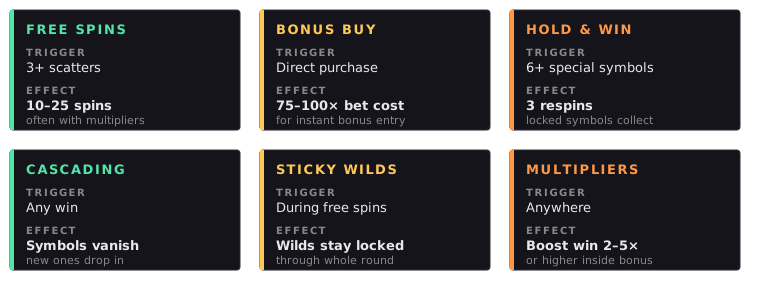
Free spins are the most familiar of the lot, and for the textbook expanding-scatter build nothing beats Book of Dead. Land three book scatters and ten free spins fire up. Just before the round starts, the game picks one symbol at random to serve as the round’s expanding symbol. Every time that symbol shows during the round it stretches to fill the whole reel and pays as though every cell on the reel carries it. The hard numbers behind the drama are 96.21% RTP, a 5,000x cap, very-high volatility, and a return profile anchored almost entirely to whether the bonus triggers in the first place. The trigger decides everything.
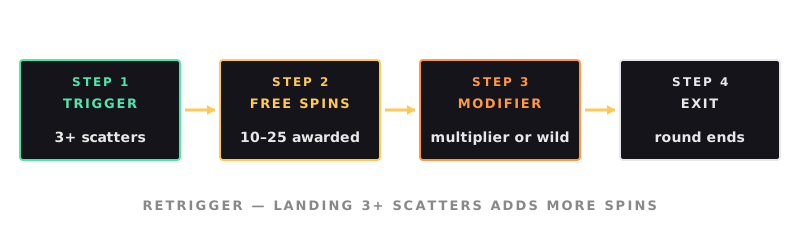
Free spins top the catalogue as the most common bonus format, no contest. The trigger pattern is consistent across most titles, usually three, four or five scatters in a single spin, but the modifier laid over the round is where they part ways: global multipliers, extra wilds, persistent wilds, symbol upgrades, each under its own provider-specific name. The mechanic you will recognise on sight. The maths underneath it you will not.
Bonus Buy (Buy Feature)
Bonus buys, or the Buy Feature, are a different route into the action, and Money Train 3 stands out here, its four-tier Buy Feature plugging straight into the Money Cart bonus. Entry prices climb from roughly 75x stake at the bottom tier to around 500x at the top. Each higher tier pre-loads more wilds and special symbols into the round’s opening layout. RTP nudges up to 96.50% while the Buy is active, against 96.10% on the base game. You pay for the shortcut.
Strip it back and a bonus buy, sometimes badged as a Buy Feature, is simply a way to purchase your way into the bonus round for a set multiple of your bet rather than a wait on scatters. Most single-tier buys are in the 75x to 100x range. Tiered builds vary the idea, and two examples show how far: Mental layers its buys around xWays and xSplit symbol selection, while Big Bass Bonanza keeps things to a single price, both of them findable in the buy a bonus category.
Every single time, what you buy is one thing: the chance to skip the scatter-trigger wait, and that skip costs you a higher up-front stake. Before you click, check the Buy-RTP value in the info panel. Some titles lift the figure, Money Train 3 among them at 96.50%; others leave it flat against base; a few, mind you, actually shave it slightly. Provider behaviour is not consistent, so it pays to look.
Hold and Win respins are a family of their own. Sun of Egypt 3 and 15 Dragon Pearls both come from 3 Oaks Gaming and run the same Hold and Win chassis under different themed art. To get in you need six or more coin symbols to land in a single spin. Each coin carries a value, and the instant it lands it locks in place for the round, after which three respins follow. Every fresh coin that lands during the respin phase locks in too and resets the counter back to three. The round closes on one of two conditions: the respin counter down to zero with no new coins, or every cell on the grid filled. It is a simple loop, and oddly tense to watch when the grid nears full.
When it ends, the prize is the sum of every locked value, with jackpot-tier rewards stacked on top in the releases that ship them. The same mechanic turns up as Link and Win elsewhere, or as Lock it Link, or under a scattering of other provider-specific brand names. The full Hold and Win category collects the rest.
Cascading reels, or tumble reels, give Gates of Olympus its visual signature, where Pragmatic Play pairs the cascade mechanic with a global multiplier that builds across consecutive cascade hits inside the bonus round, the whole thing set at 96.50% RTP and high volatility with a 5,000x ceiling. The motion sells itself.
The core motion is simple. Any symbols that feed a paid hit vanish from the grid, new symbols drop into the empty cells, and they very likely form another paid combination on the way down. The chain rolls on until a spin lands no win, and there the round stops. Whichever provider ships it, the same mechanic answers to tumble, avalanche or cluster cascade, but do not let the labels fool you: the behaviour underneath is one and the same.
That leaves the modifier set itself, taken symbol by symbol. Two slot-led examples are enough to cover two different wild patterns. The Dog House runs sticky wilds with attached multipliers through its free spins round, so when a wild lands during the bonus it locks for the rest of the round and its multiplier, either 2x or 3x, applies to every win it touches. Razor Shark does something else entirely: mystery stacks land, reveal expanding scatter or wild symbols underneath, and those then expand to fill whichever reel they landed on.
So there you have the two patterns. An expanding wild arrives as a single symbol and grows to fill an entire reel, so it multiplies the number of lines it can contribute to. A sticky wild is the opposite: it does not grow, but stays locked in place across several later spins, most often for the length of a free spins round.
Multipliers and scatters both break the standard payline rule, but they break it in opposite directions. A scatter pays from anywhere on the grid, wherever it lands, and doubles as the bonus-round trigger when enough of them show in a single spin. A multiplier pays nothing by itself; it amplifies a win it attaches to by a fixed or variable factor, and some titles let it stack across the bonus round rather than reset between spins. That rising pattern, where the figure climbs across consecutive free spins, is the persistent-multiplier variant.
Some features roll the two into one. The fisherman in Big Bass Bonanza is the worked example: scattered multiplier values land across the grid, and the wild symbol sweeps them all into a single payout whenever it lands during the free spins round.
Bankroll Management Basics
Bankroll management is just session planning under a fancier name (and kept as a budget, not a bet, it becomes the single habit that saves a session from ending badly). Three decisions are underneath it: how much money goes into the session, how big each spin runs, and, the one people always skip, what actually pulls the session up before it spirals. Think of it as a budget, not a strategy.
Start by setting the session bankroll. For most AU pokies sessions the figure is somewhere between A$50 and A$500, with the right point inside that range keyed to your stake level and the volatility of whatever title sits in the tab. That amount is meant to cover one play session alone, so wall it off from the rest of your money.
The upper edge of the range makes more sense with a title like Money Train 3 in front of you: a 100,000x cap, an extreme volatility rating, a base game happily capable of running hundreds of spins before the Money Cart bonus deigns to trigger. A bankroll built for short base-game play is nothing like one built to wait out that feature, not even close.
Well, pull that into a rule of thumb. Higher-band bankrolls are for higher-volatility games, where the bonus takes longer to arrive and the session needs more spins to survive the wait; lower-band bankrolls are for low-volatility titles that keep the base-game returns steady.
Bet sizing runs on a 1-2% rule, though one exception deserves a mention first. A 3-5% bet size is fine for short sessions, or for low-volatility titles where dry-stretch risk stays low and the whole point is bigger hits per spin. That is the edge case, and the only one there is.
By default that is 1-2% of the session bankroll, which in practice lands like this:
- Take an A$200 bankroll → A$2 to A$4 per spin, which is the band I reach for on a quiet night; it pairs cleanly with Big Bass Bonanza at medium-high volatility.
- Move up to A$500 → A$5 to A$10 per spin. That is roomy: it buys enough spins to sit out a cold run without your thumb hovering over the deposit button.
- Push to A$1,000 → A$10 to A$20 per spin. Plenty, sure. And yet the percentage is what does the disciplining here, not the size of the pile.
Why keep the percentage that small? Because high-volatility games can run a long, long way between bonus triggers, and the session needs the spin count to outlast the wait (and the moment a payout starts to feel owed, that is the cue to walk, not to deposit). Burn through the bankroll too fast and the bonus never quite seems to arrive in time to matter.
Win and loss limits are the third decision. Try this on something like Gates of Olympus: high volatility, 5,000x cap, a return that leans hard on the bonus. Set the stop-loss and the stop-win before the first tumble sequence. Decide it cold. Skip that, and the pull to chase one more cascade and quietly rewrite the plan mid-session wins nine times out of ten.
Decide both limits before the session starts, and write them down. A stop-loss ends the session once a set slice of the bankroll is gone, with 50% the standard example; a stop-win ends it once winnings hit a set multiple, with 100%, doubling the original bankroll, as the example figure.
Add a 60 to 90 minute time cap and a break for a third boundary, so set that timer before the first spin, not after the first bonus miss. That second timer, the one that is set mid-tilt, is never among the good calls.
Underneath all of it is the line between bankroll and disposable income. Pokies bankroll comes out of disposable income, or whatever remains once you have covered rent, bills, savings, essentials. It is money specifically ring-fenced for entertainment. If you cannot isolate the number before you log in, it is not a session bankroll, and you know it.
None of that eases up on a format like Aviator, where rounds last seconds and the cash-out call feels fast and harmless. Short-format play does not lower the bar for separated funds; if anything it raises it, since stake exposure is faster per minute of session time. Ten quick rounds can bleed more than one slow spin ever would, and frankly they almost never feel like it.
How to Choose an Online Pokie
Which levers actually narrow a catalogue down? Four selection factors, or perhaps five if you count yourself fussy, do most of the work: RTP, volatility, theme, mobile compatibility. The first two are maths, the last two are preference, and it helps to keep the two halves separate in your head.
Matching RTP and volatility to how you play does the real filtering, so start with RTP. The 96% mark and above sets the threshold for longer sessions and slower bankroll burn: pick high, skip low. Shorter sessions lean more on theme and feature set, but once a session runs past 30 minutes, RTP quietly takes over the bankroll work. And do not forget the panel: the in-game info screen alone locks the deployed RTP version, since the same title can ship at 96.5% on one operator and 94% on another. Check it, every time.
Volatility fills the other half, and the failure case teaches it fastest. Pick a 50,000x or 100,000x title, bring an A$80 bankroll, stake A$2 a spin, and the session dies before the bonus ever arrives. The maths model needs the spin count, and the spin count needs the bankroll. Work back from that: an A$50 to A$200 session is right for low volatility and players who like steady action without long dry stretches; medium volatility slots in as the default for most session sizes and tastes; high volatility wants an A$500-plus bankroll, or a bet size down at the lower end of the 1-2% rule, precisely because the dry stretches between triggers can run long.
Theme and device are the softer half. Set Big Bass Bonanza, Gates of Olympus and Mental side by side and you have got fishing, mythology, horror, three themes with only a reel grid in common. Theme changes your attention span and your tolerance for the grind, but it will not touch the RTP figure or the max-win cap, not by a single point. That is preference at work, and it sits outside the maths model entirely. Egyptian mythology, Norse gods, sweets, anime, horror, sports: the symbol set changes while the volatility band stays put.
What genuinely counts inside the theme question is engagement, because people stick with titles they actually enjoy the look of. Provider style is the layer on top of that. Pragmatic Play, Play’n GO, NoLimit City, Push Gaming, Relax Gaming each carry recognisable house patterns in their symbol art and animation, plus their bonus design, while the underlying maths holds steady and the feature rhythm absolutely does not.
Device, honestly, is the easiest to settle of all. The in-game maths reads identical across platforms, so the same title plays at the same RTP and volatility on phone or desktop. The maths does not care. Mobile-first design has been the default since 2020, with developers who build the UI for touch and small screens before they adapt it for desktop, though pre-2020 titles can still render in landscape only or throw up desktop-style buttons that will not reflow cleanly to portrait.
Responsible Gambling in Australia
Any licensed AU wagering account points you to three practical controls, and none of them is complicated: account limits for day-to-day control, BetStop for exclusion, then Gambling Help Online, on 1800 858 858, for counselling. Match each one to the job it handles.
Setting Personal Limits
Dig into the account settings and there are four action levers:
- Cap deposits (daily, weekly or monthly)
- Cap session length
- Cap losses
- Force reality-check pop-ups during play
Set them before the first deposit, so the limits are live before any session even starts.
Self-Exclusion via BetStop
A BetStop registration blocks the registered person from every licensed Australian online wagering service for a chosen period, anywhere from three months out to lifetime, and that is the whole span covered. The register itself, the National Self-Exclusion Register, is run by the Australian Communications and Media Authority (ACMA).
Registration is free and happens online, and it applies across every AU-licensed operator automatically, with nothing to chase up operator by operator.
Gambling Help Online
For counselling, call 1800 858 858; the line is open 24/7. Web chat and email are available too, both through Gambling Help Online at gamblinghelponline.org.au.
And the gambler need not be the one who makes first contact. Family and friends can reach the service just as well, and the intake handles both routes without fuss.
Recognising Problem Gambling
Screening tools tend to watch for six behaviours, and they are grouped into three pairs:
- Money signs: spending more than was planned, chasing losses with larger bets
- Secrecy signs: hiding gambling activity from family, borrowing money to gamble
- Functioning signs: neglecting work or relationships, feeling restless or anxious when not gambling
Reach for Gambling Help Online when you need counselling, and BetStop when the situation calls for account-level blocking.
FAQ
What is RTP in online pokies?
Take the catch first, because it trips people up: providers often ship the same title in several RTP builds, and the casino chooses which one goes live. Once you have confirmed the deployed figure in the in-game info panel, the number is the theoretical long-run payback per A$100 wagered, so a 96% reading means A$96 returned per A$100, measured across millions of simulated spins. That figure is an average smeared across all those spins, though, never a promise for your afternoon. Most pokies are between 95% and 96.5%.
What is volatility in pokies?
Two pokies both rated 96% RTP can feel like entirely different games, one that hands you steady A$0.50 hits across the session while the other goes cold for thirty spins and then drops a 200x line. Volatility is what drives that difference. The scale is low, medium, high, very-high, and it is independent of RTP. Low volatility delivers frequent small wins and short dry stretches. High volatility delivers rare large wins and longer dry runs. Same RTP, different ride.
Are online pokies random?
The practical correction comes first: previous spins do not influence the next one. A 30-spin cold stretch does not load the next spin toward a bonus trigger, however much it feels like it should. Each spin outcome is an independent result from a certified random number generator. The main independent labs, eCOGRA, GLI, iTech Labs, audit the RNG output of pokies offered by AU-licensed operators and confirm the advertised RTP figure.
What is a bonus buy feature?
Worked example: Money Train 3 and Mental both run tiered bonus buys, from around 75x stake at the low tier up to 500x at the top. The buy skips the scatter-triggered wait, and the trade for that is a higher up-front stake. Tiered options at different prices unlock different bonus versions, so Money Train 3 pre-loads more wilds at higher tiers while Mental layers xWays and xSplit symbols on top of the base buy. Standard single-tier buys are 75x to 100x.
What is the difference between paylines and ways to win?
Row position is the clearest divider. Paylines care about the row pattern, so a 20-payline pokie pays on 20 fixed patterns read left to right, and a symbol on the wrong row misses out. Ways-to-win designs ignore the row entirely and pay whenever matching symbols land on adjacent reels from left to right. A 243-ways title covers every combination on a 5×3 grid; Megaways titles climb to 117,649 ways per spin, because the reel height is variable.
How much bankroll do I need to start?
Stake size answers this before bankroll does, since a A$2 spin and a A$10 spin point at very different bankrolls even on the same title. Work from the 1-2% rule: A$2 spins are right for an A$100 to A$200 opening bankroll; A$5 spins fit A$250 to A$500; A$10 spins start at A$500. High-volatility titles push toward the upper end of each band, because they need more spins to reach the bonus round. Honestly, the blunt version is this: settle the stake first, then bring the bankroll that lets it breathe.
Are mobile pokies the same as desktop?
Same maths, different interface. RTP, volatility, hit frequency, max win cap: all of it is the same between platforms. The phone-specific checks are practical ones: confirm the title runs in portrait if that suits how you play, that the button size feels comfortable for the bet you place, and that the info panel renders readably without a zoom. Studios design pokies from 2020 onward mobile-first, then adapt the desktop build from the mobile version.
Where can I find responsible gambling support in Australia?
Use the procedure, not the brochure. For counselling, call 1800 858 858, which connects you to Gambling Help Online, and they also run web chat and email at gamblinghelponline.org.au. For account-level blocking, register at betstop.gov.au, the National Self-Exclusion Register that is operated by ACMA. Either route works whether the gambler reaches out or family and friends do it for them.